.jpg?width=1600&name=String%20Furniture%20(2).jpg)
Challenge

String sells to retailers in 44 countries. But when it came to selling directly to consumers, scaling beyond their existing markets was slow. They had operations in several European countries, but the administrative burden of launching and managing each new market held them back. Their previous platform simply couldn't handle swift expansion to new markets.
"The solution we had couldn't handle our needs. It was that simple," says Daniel Källstrand Modig, CTO at String Furniture.
String's product range is complex, a modular shelving system is sold very differently from a desk or a bureau. They needed a platform flexible enough to handle that complexity, while also managing multiple currencies, VAT rates, and pricing structures across markets.
"The ability to flexibly integrate it ourselves was essential. We didn't want to be locked into a framework that dictates how everything has to be built."
Daniel Källstrand Modig,
CTO at String Furniture.
.jpg?width=1200&height=628&name=String%20Furniture%20(1).jpg)
Action
.jpg?width=800&height=1000&name=Case%20bilder%20-%20String%20-%20Norce%20(1).jpg)
String needed a platform that wouldn't box them in. Headless. API-first. With a strong PIM. And full freedom to build their own logic on top.
"The ability to flexibly integrate it ourselves was essential," says Daniel. "We didn't want to be locked into a framework that dictates how everything has to be built."
With Norce Commerce as the foundation, String built a modern e-commerce stack:
- Storyblok for CMS
- Voyado Elevate for search and personalisation
- HubSpot for B2B CRM
- Voyado Engage for D2C CRM
- Integration with BusinessCentral ERP
- LogTrade for TSM
On top of this, String built their own service layer to manage the complexity of multi-market commerce, including different VAT rates, currencies, and pricing structures worldwide.
The Norce PIM manages their entire product portfolio, from modular shelving systems to desks and bureaus. Everyone works from the same product data, and launching a new market no longer means rebuilding the catalogue.
"We have all the product data gathered. We have the routines ready in our service layer," We basically just need to activate prices on a market. Then we can plug it in directly."
"It's the flexibility and simplicity of getting to market that matters most to us."
Daniel Källstrand Modig,
CTO at String Furniture.

Impact
String has sold to retailers worldwide for decades. Now they can finally sell directly to consumers, on their own terms, in their own pace.
They launched on Norce in August 2025. Within four months, they had rolled out five new European D2C markets: Spain, Portugal, Italy, Poland, and the UK.
Before Norce, String couldn't sell directly to consumers outside Scandinavia. Today, they can enter a new market as fast as they can set prices.
"It's the flexibility and simplicity of getting to market that matters most to us," says Daniel.
The limitations are gone. With Norce as the commerce engine and their own service layer on top, String fully controls how and where they expand.
.gif?width=800&height=800&name=Mockups%20mobildesktop%20String%20Furniture%20(1).gif)
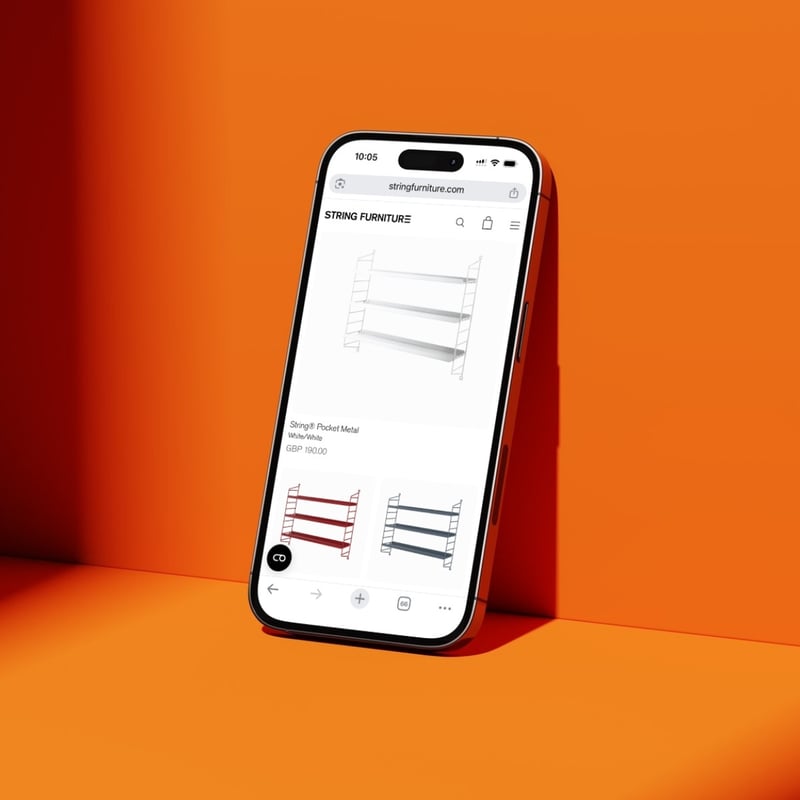
The Norce PIM has delivered as well. Despite the complexity of String's product range, the team spends the same amount of time managing it and gets more value out of it.
For brands with global ambitions and complex products, String's approach shows what's possible: build the foundation once, then scale without starting over.




.png?width=400&height=150&name=LogTrade%20(1).png)