We sat down with CTO Benny Olsson who shares key takeaways from Norce’s modernisation journey, from rock-solid Black Week performance to AI becoming a core capability. 2025 was a year of real transformation for Norce Commerce, not just under the hood, but in ways our customers could feel what performance really means.
From a CTO perspective, what are you most proud of in Norce’s modernisation journey this year?
From a CTO perspective, I’m most proud that we’ve really turned our modernisation work from a “nice to have” into a tangible, visible advantage for our customers. We’ve spent the year carefully reshaping a large inherited legacy codebase into a modern, cloud-ready platform – and we’ve done it without slowing down the roadmap. Moving our core services onto a modern .NET platform has given us better performance, higher stability and a codebase that’s significantly easier to maintain and evolve. You can see the results today in faster, more reliable APIs for the customers who are already on the new stack.
If I look at specific milestones, three stand out:
- Making AI a core part of how we work
We made a deliberate decision to use AI to handle much of the heavy lifting in the modernisation effort. That allowed our teams to keep delivering new product capabilities in parallel, instead of choosing between “modernise” or “innovate”. - Modernising our most complex public API with 100% backwards compatibility
Our Commerce API is the heart of many customers’ solutions. We managed to modernise it while keeping it fully backwards compatible, so partners and customers could switch to the new version without changing their integrations. That was the make-or-break requirement for a seamless rollout. - Proving it in peak season
Before Black Week, we already had a majority of customers – and most of the traffic – running on the new API. During Black Friday, both the old and the new API delivered 100% uptime. For me, that was the ultimate validation that our modernisation journey is not just an internal tech project, but something that directly protects and adds value for our customers.
We’ve just passed Black Week, how did the platform perform during peak load this year, and what learnings are you taking into the holiday season?
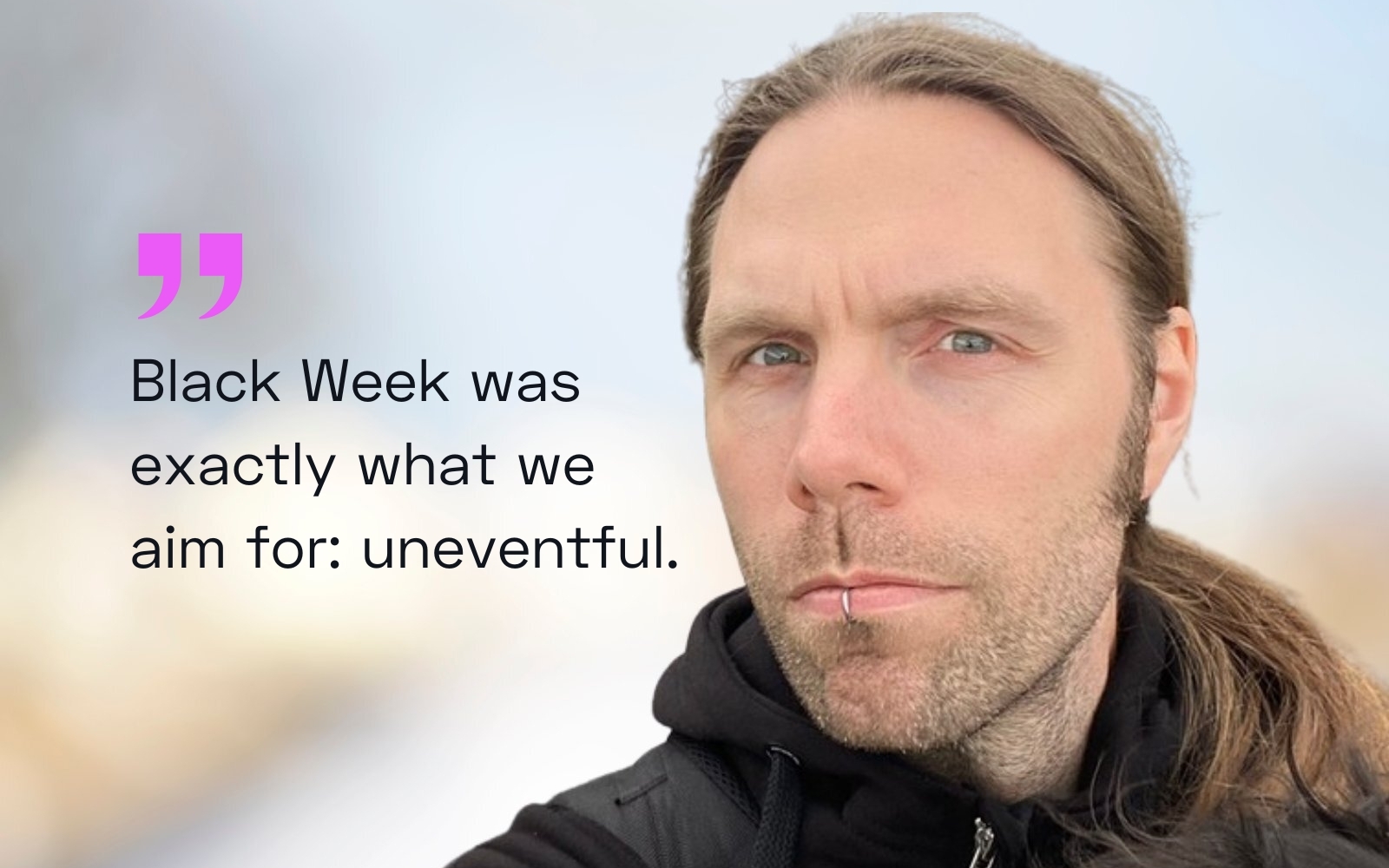
From a platform perspective, this year’s Black Week was exactly what we aim for: uneventful. We had 100% uptime and response times we’re genuinely pleased with. In conversations with customers and partners afterwards, a recurring comment was that it was “almost boring – everything just worked.” As a CTO, especially after a year of focused modernisation, that’s about the best feedback I can imagine.
A big part of this is that Norce Commerce has been designed for scalability from day one, and our modernisation work is raising the bar on an already battle-tested platform. The architectural decisions we’ve made around using Azure’s native scaling capabilities, combined with targeted optimisations in our APIs and infrastructure, really paid off. The fact that most of our traffic was already running on the new, modernised Commerce API gave us both better performance and more predictable behaviour under load.
The somewhat counterintuitive learning this year is that we probably don’t need to prepare as heavily for next Black Week as we did this year. With the architecture we now have in place, and as the modernisation journey moves towards 100% completion, we’ll be able to lean even more on “scalability on autopilot” – letting the platform scale up and down with demand across the entire stack, rather than relying on one-off peak preparations.
Norce has invested heavily in stability and performance, but what does “performance” mean in 2025?
In 2025, “performance” is still about speed – but it’s no longer only about speed. From my perspective as CTO, good performance means that the platform is fast, predictable, and frankly a bit boring even when everything around it is changing: traffic spikes, new features shipping, external systems misbehaving. It’s about how the system behaves under real-world conditions, not just in a benchmark.
For Norce Commerce, that breaks down into a few dimensions:
- Speed and scalability – Our APIs need to respond quickly and scale smoothly with demand so that partners don’t have to think about capacity planning every time a client runs a campaign. That’s the “classic” view of performance, and it still matters a lot.
- Resilience and isolation – One slow integration, one misconfigured feed, or one traffic spike shouldn’t be able to drag a whole shop – or worse, the whole platform – down. Performance for us means designing for failure: circuit breakers, timeouts, retries and patterns that keep the core commerce flows healthy even when something around them is struggling.
- Observability and operability – You can’t have real performance without being able to see what’s going on. The work we’ve done on metrics, logging and tracing means we can detect issues early, understand where time is spent, and fix bottlenecks before they become customer problems. That’s performance, too.
- Smarter integrations, not just “more integrations” – As an API-first platform, a lot of perceived performance sits at the seams between Norce and other systems. Using better integration patterns – async where it makes sense, smart caching, bulk and event-based operations instead of chatty synchronous calls – is just as important as optimising our own code paths.
So, when we talk about investing in performance, we’re not chasing theoretical microseconds. We’re investing in a platform where merchants, partners and their customers experience fast, stable, and dependable commerce – even when nobody sees the complexity under the hood.
AI has started to play a role in development, what’s your broader view on how AI will influence commerce tech and Norce in 2026?
If there’s one thing I’ve learned this year, it’s that making confident predictions about AI more than a few weeks out is mostly a lottery. Things are moving at breakneck speed – just look at how quickly initiatives like OpenAI’s Instant Checkout are evolving and expanding. So, I’m very careful about pretending to know exactly what 2026 will look like. That said, there are some clear trends and directions that we both can see and are actively acting on at Norce.
For us, three areas stand out:
- Agentic Commerce moves from slides to reality
Agentic Commerce is no longer a buzzword. It’s something merchants and platforms actually need to be ready for. And for Norce, it’s much broader than just OpenAI’s Shopping Research or Instant Checkout, or “getting your products into ChatGPT/Gemini/Claude/Grok.”
It’s about agents interacting directly with the commerce platform itself – helping B2B buyers with complex purchases, powering conversation-assisted shopping in the webshop, automating repetitive tasks, and connecting deeply into the APIs. Norce Commerce is extremely well positioned here. Our API-first architecture and our work on the Commerce MCP (Model Context Protocol) Server give us a very strong foundation. What we previewed at Norce Engineering Day is just the first step in a longer Agentic Commerce journey. - AI becomes invisible – and expected
By 2026, “we use AI” won’t be a differentiator, it will be table stakes. Nobody is going to be impressed just because there’s an AI label on a feature. What matters is how well it’s integrated into real workflows.
A good example is product management: generating product descriptions, FAQs, translations and other content from metadata and images will simply be expected functionality in a modern commerce platform. The exciting part for me is not that we use AI there, but how seamlessly we can fit it into our PIM and admin workflows so that it actually saves time and improves quality for merchants and partners. Some of these features are in preview-mode, others are in active development. - AI-accelerated product development and a more fluid roadmap
The other big shift is how we build the product itself. In a landscape that changes this fast, you can’t lock yourself into a highly detailed, six-month roadmap and treat it as scripture. You still need a clear product vision and strategic direction – but you also need the ability to re-prioritise and change course much more often than before.
The only realistic way to do that without burning out your teams is to embed AI deeply into the software development lifecycle: using it for code, tests, documentation, analysis, prototyping – so that human engineers can focus on architecture, experience and long-term value, while AI helps with the heavy lifting and keeps execution speed high.
So, my broader view is that in 2026, AI will influence commerce tech at every layer – from how shoppers interact with merchants, to how merchants manage their catalogues, and how we as a product company design, build and evolve Norce Commerce. Our job is to make sure that influence is concrete, trustworthy and genuinely useful – not just a new buzzword on a slide.
If you could give one piece of strategic advice heading into 2026, what would it be?
If I had to boil it down to one thing, it would be this:
Start building an AI-native, agent-ready culture now – not just an AI-enabled product.
Agentic Commerce and AI-accelerated work won’t just show up in a few “smart features” in your webshop. They will cut across everything: how customers discover and buy, how merchandisers work with products, how support is handled, how finance reconciles orders, how IT runs operations. The organisations that win are the ones that treat AI and agents as a capability that belongs everywhere – in their APIs, their data model, their processes, and their way of working – not as a side project in the product team.
The other reason this is urgent is generational. 2026 is likely the first year where a graduating class has had large-scale access to LLMs (Large Language Models) throughout most of their time at university. They’re “AI-native” in the same way my generation became “internet-native” in the late 90s. Back then, the internet was slowly being adopted by people already in the workforce – but it was when the first internet-native graduates hit the job market that things really took off, and a few years later we had companies like Amazon, Google, PayPal and Skype reshaping entire industries.
I’m convinced we’re about to see a similar shift. The next generation will expect to work with AI by default – to automate the boring parts, to explore ideas faster, to interact with systems through agents instead of forms. My strategic advice is to make sure your organisation, your culture, and your commerce platform are ready for that mindset. If you treat AI as the new normal rather than a novelty, you’ll be in a much stronger position when this shift moves from “interesting” to “inescapable.”
.jpg?width=600&name=Engineering%20Day%20(1).jpg)